
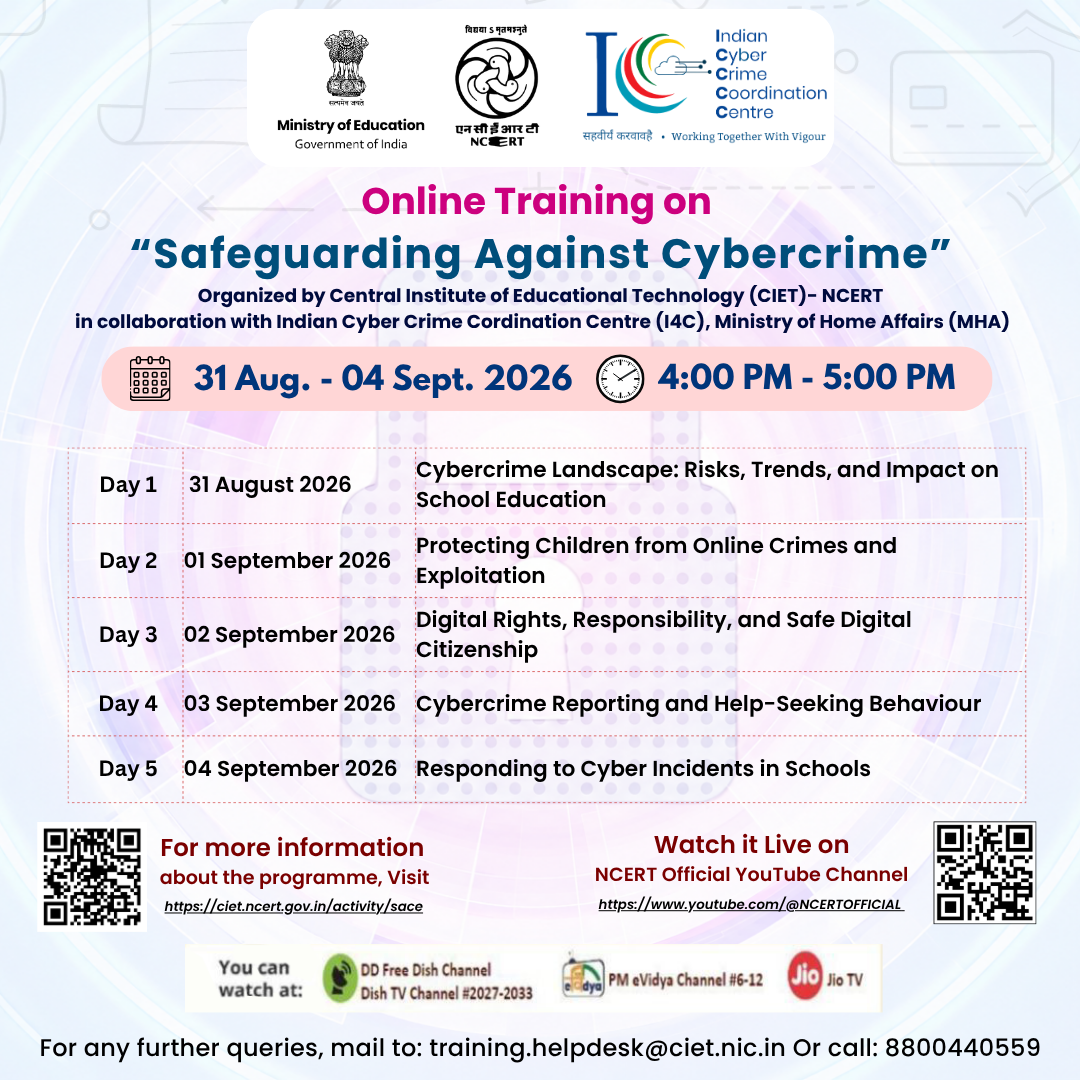
Online Training on
Safeguarding Against Cybercrime
The National Education Policy (NEP) 2020 envisages that the integration of technology in education must be accompanied by measures that ensure safe, ethical, and responsible digital engagement. It emphasizes the transformative role of technology in improving access, equity, quality, and educational planning, while also recognizing the need to address concerns related to digital safety, privacy, and security (Chapter 23: Technology Use and Integration, Sections 23.1–23.8). In this context, training on cyber safety and security is crucial for equipping learners, teachers, teacher educators, parents, and other stakeholders with the knowledge and skills required to protect personal data, identify cyber threats, prevent online fraud and cyberbullying, and promote responsible digital citizenship. Such capacity-building initiatives contribute to the creation of secure digital learning environments and support the effective, safe, and inclusive implementation of technology-enabled education as envisioned in NEP 2020.
Today, the internet and digital technology have become an important part of our daily lives. We use digital platforms for education, communication, shopping, banking, and entertainment. However, the increasing use of technology has also increased the risk of cybercrime. Cybercrime includes activities such as online fraud, hacking, cyberbullying, identity theft, phishing, online harassment, and misuse of personal information. Children and young people may be more vulnerable because they spend a lot of time online and may not always be aware of these risks. Safeguarding against cybercrime means being aware of online risks and taking simple steps to stay safe. We should use strong passwords, keep personal information private, avoid clicking on unknown links, and be careful while communicating with unknown people online. We should also use social media and other digital platforms responsibly.
Parents and teachers have an important role in guiding children about safe and responsible use of technology. Children should be encouraged to speak to a trusted adult if they experience cyberbullying, online harassment, fraud, or any other uncomfortable situation. It is also important to know how to report cybercrime and seek help. People should not feel afraid or embarrassed to report an online incident. Timely reporting can help prevent further harm and protect others. Safeguarding against cybercrime is a shared responsibility of students, teachers, parents, schools, and the wider community. By creating awareness and developing safe digital habits, we can make the online environment safer and more secure for everyone.
Recognizing the growing need to strengthen awareness and protective skills among educators and learners, CIET-NCERT is organizing an online training programme on “Safeguarding Against Cybercrime" in collaboration with Indian Cybercrime Coordination Centre (I4C). The training aims to promote safe, responsible, and positive use of technology and help everyone become a more aware and responsible digital citizen.The programme will also support understanding cyber risks, follow safe digital practices, protect children from online threats, and respond appropriately to cyber incidents.
Objectives of the Training :
On completion of the training, learners will be able to:
- Understand the cybercrime landscape, emerging threats, and their impact on students, teachers, schools, and the educational ecosystem.
- Identify common cybercrimes and forms of online exploitation, including cyberbullying, online harassment, gaming-related crimes, online grooming, social media exploitation, deepfakes, and AI-enabled abuse.
- Recognise warning signs of cybercrime, online exploitation, and digital harm, and understand appropriate child protection and support measures.
- Develop safe, responsible, and ethical digital practices, along with appropriate help-seeking and reporting behaviour.
- Report cyber incidents through appropriate school-level and national mechanisms, including the National Cyber Crime Reporting Portal, while addressing barriers such as fear, shame, and hesitation.
- Apply basic cyber incident response practices in schools, including appropriate escalation, confidentiality, student protection, and preservation of relevant digital evidence.
Programme Schedule :
| Day & Date | Title of the Session | Name of the Resource Persons | Banner Link | Presentation link | Video Link |
|---|---|---|---|---|---|
|
Day 1: Monday 31 August, 2026 |
Cybercrime Landscape: Risks, Trends, and Impact on School Education | Dr. Deepak Kumar, Senior Technical Program Manager, I4C, MHA, New Delhi - 110001. | Day 1 | Presentation-1 | Video |
|
Day 2: Tuesday 01 September, 2026 |
Protecting Children from Online Crimes and Exploitation | Ms. Sangeeta Mazumder, Constable, Andaman & Nicobar Police, I4C, MHA, New Delhi - 110001. | Day 2 | Presentation-2 | Video |
|
Day 3: Wednesday 02 September, 2026 |
Digital Rights, Responsibility, and Safe Digital Citizenship | Ms. Sumedha Handa, Vulnerability and Threat Management Professional, I4C, MHA, New Delhi - 110001. | Day 3 | Presentation-3 | Video |
|
Day 4: Thursday 03 September, 2026 |
Cybercrime Reporting and Help-Seeking Behaviour | Ms. Kajal Kashyap, Cybercrime Researcher, I4C, MHA, New Delhi - 110001. | Day 4 | Presentation-4 | Video |
|
Day 5: Friday 04 September, 2026 |
Responding to Cyber Incidents in Schools | Ms. Nisha Pandey, Professional Ecosystem Expert, I4C, MHA, New Delhi - 110001. | Day 5 | Presentation-5 | Video |
|
Organising Team Programme Advisory:
Prof. Amarendra P. Behera, Joint Director, CIET-NCERT, New Delhi.
Programme Coordinator and Course Coordinator : Dr. Angel Rathnabai, Associate Professor, CIET-NCERT, New Delhi. Technical Coordinator:
Dr. Varsha Yadav, Academic Consultant, CIET-NCERT, New Delhi.
|
|||||
Modality
The sessions of this online training will be broadcast live on NCERT’s Official YouTube Channel - https://youtube.com/ncertofficial and simulcast on PM e-Vidya DTH TV Channels (6–12) from 4.00 pm - 5.00 pm. The session will also be telecast live on the following channels:
- DD Free Dish Channel
- DISH TV Channel #2027-2033
- Jio TV mobile app
Recorded sessions will also be available through a dedicated YouTube playlist. Learners can watch these live sessions/ recorded recorded sessions to enhance their understanding of that particular theme.
If learners want to earn a certificate that is considered as part of the 50 hours of CPD, then they should join the online course offered through DIKSHA using the course link that will be made available on the next day of the live session. Once the learner joins the course and completed the following, they will receive the digital certificate in the portal itself. The certificate will be available in their profile page as well. They can download the certificate and also access the certificate in the digilocker.
- Consume all the digital resources provided in the course
- Participate in the activities given in the course
- Take the final assessment and score 70% and above within three attempts
- Fill the feedback form
How to take part in the course?
Important Dates:
| Course Title | Dates |
|---|---|
| Safeguarding Against Cybercrime |
Live Session: 31 August–04 September, 2026 Course Enrolment Opening Date: 05 September, 2026 Course Enrolment Closing Date: 10 March 2027 Course Closing Date: 15 March, 2027 |
Learners who want to attend live session but do not aim for certificate, follow the given step:
- Watch the live sessions in NCERT official YouTube channel/ PM eVidya DTH TV channel and interact with the experts. Recording of the sessions can also be accessed from the playlist link:
https://www.youtube.com/playlist?list=PLJCQOxzfCdQE
Learners who aim for certificate, follow the given steps:
- Step 1: Register in DIKSHA. Link your APAAR ID and digi locker ID (If you do not have an APAAR or Digilocker ID, create one and then add the details in the DIKSHA portal). If this is already done, this step may be skipped.
- Step 2: Join the online course using the course link.
https://learning.diksha.gov.in/diksha/course.php?id=1594§ion=3190
(Refer to the tutorial to understand the process of joining a course - https://www.youtube.com/playlist?list=PLcsj1x9n9h4j0TtGCy_jKJyEX7y6mD6Rs). - Step 3: Watch the videos given inside the course.
- Step 4: Complete all the activities given in the course, like discussion forum, interactive activities, assignments etc.,
- Step 5: Take the final assessment. Three attempts can be tried. 70% and above is the eligibility to get a certificate. In case you couldn't get 70% and above within three attempts, you will not be eligible to get a certificate.
- Step 6: Learners who meet all the criteria will get the digital certificate, and they can access the certificate in their profile page.
For any queries, mail to:training.helpdesk@ciet.nic.in or call: 8800440559.