
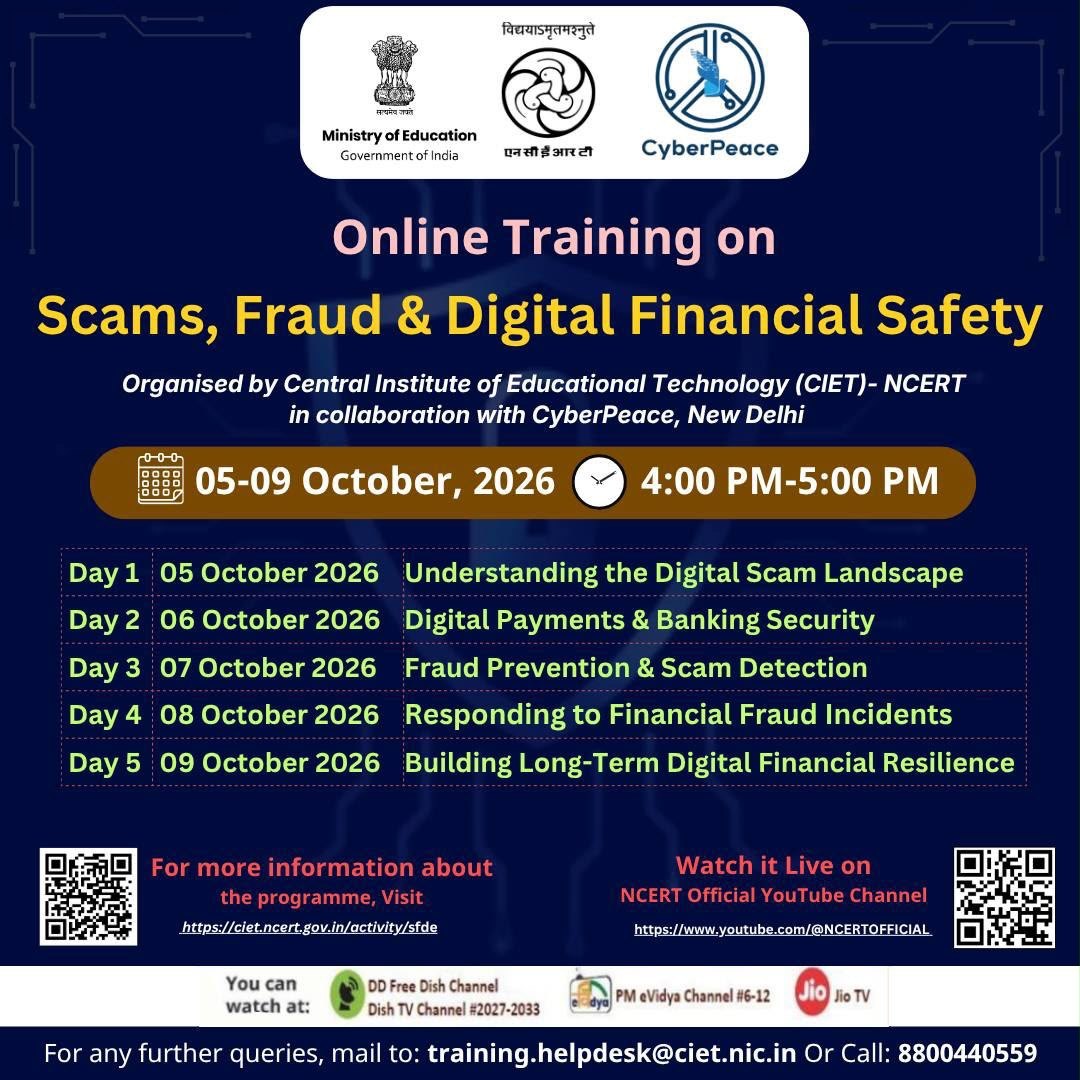
Online Training on
Scams, Fraud & Digital Financial Safety
The National Education Policy (NEP) 2020 recognizes the importance of developing awareness, skills, and responsible practices for meaningful and safe engagement with technology. It emphasizes the need to enable learners and citizens to understand the potential and effects of technology, make informed choices, and develop awareness of privacy, laws, ethical issues, and data protection in the digital environment (Chapter 23: Technology Use and Integration). With the growing use of digital platforms, online services, and digital payment systems, awareness of scams, fraud, and financial risks has become an important aspect of digital literacy. In this context, training on Scams, Fraud & Digital Financial Safety aims to equip learners, teachers, teacher educators, parents, and other stakeholders with the knowledge and skills to identify common digital scams, recognise fraudulent messages and requests, safeguard personal and financial information, use digital payment services carefully, and respond appropriately to suspected fraud. Such capacity-building initiatives can promote informed decision-making, responsible digital practices, and greater awareness of financial safety in an increasingly digital environment, in line with the broader vision of NEP 2020 for safe, ethical, and responsible use of technology. The rapid expansion of digital payments, online banking, e-commerce and technology-enabled financial services has transformed the way individuals and businesses access and manage money. Alongside these developments, however, there has been a corresponding rise in sophisticated scams and financial fraud, including phishing, smishing, vishing, investment and loan scams, job and romance frauds, identity theft, account takeovers and AI-enabled impersonation. The increasing use of social engineering, deceptive digital interfaces and emerging technologies has made financial scams more difficult to recognise and prevent. In this context, strengthening digital financial awareness and building practical capacities to identify, prevent and respond to scams is essential for creating a safer and more resilient digital environment.
Recognizing the growing need to strengthen awareness and protective skills among educators and learners, CIET-NCERT is organizing an online training programme on “Scams, Fraud and Digital Financial Safety” in collaboration with CYBERPEACE (Training & Capacity Building) . The training aims to promote safe, responsible, and positive use of technology and help everyone become a more aware and responsible digital citizen. The programme will also support understanding cyber risks, follow safe digital practices, protect children from online threats, and respond appropriately to cyber incidents.
Objectives of the Training :
On completion of the training, learners will be able to:
- Build awareness of common and emerging scams and forms of digital financial fraud.
- Enable participants to identify warning signs, deceptive tactics and social-engineering techniques used by fraudsters.
- Promote safe and responsible use of UPI, mobile banking, digital wallets, cards and online payment platforms.
- Strengthen participants' understanding of financial and digital security practices.
- Explain appropriate reporting, evidence-preservation, recovery and dispute-resolution mechanisms following a fraudulent transaction.
- Encourage long-term digital financial resilience among individuals, families, communities and vulnerable user groups.
Programme Schedule :
| Day & Date | Title of the Session | Name of the Resource Persons | Banner Link | Presentation link | Video Link |
|---|---|---|---|---|---|
|
Day 1: Monday 05 October, 2026 |
Understanding the Digital Scam Landscape | Ms. Anindita Mishra,Senior Trainer, CyberPeace, New Delhi – 110001 | Day 1 | Presentation-1 | Video |
|
Day 2: Tuesday 06 October, 2026 |
Digital Payments & Banking Security | Prof (Dr.) Shilohu Rao, Professor (Law) & Research Director, Centre of Excellence for Research and Application (CERA), NLU Jodhpur - 342304 | Day 2 | Presentation-2 | Video |
|
Day 3: Wednesday 07 October, 2026 |
Fraud Prevention & Scam Detection | Mr. Naman Shridhar, Senior Researcher, CyberPeace, New Delhi – 110001 | Day 3 | Presentation-3 | Video |
|
Day 4: Thursday 08 October, 2026 |
Responding to Financial Fraud Incidents | Dr. Gaurav Gupta, Scientist, Ministry of Electronics and IT, Electronics Niketan, Lodhi Road, New Delhi - 110003 | Day 4 | Presentation-4 | Video |
|
Day 5: Friday 09 October, 2026 |
Building Long-Term Digital Financial Resilience | Major Vineet Kumar, Founder and Global President, CyberPeace, New Delhi – 110001 | Day 5 | Presentation-5 | Video |
|
Organising Team Programme Advisory:
Prof. Amarendra P. Behera, Joint Director, CIET-NCERT, New Delhi.
Programme Coordinator and Course Coordinator : Dr. Angel Rathnabai, Associate Professor, CIET-NCERT, New Delhi. Technical Coordinator:
Dr. Varsha Yadav, Academic Consultant, CIET-NCERT, New Delhi.
|
|||||
Modality
The sessions of this online training will be broadcast live on NCERT’s Official YouTube Channel - https://youtube.com/ncertofficial and simulcast on PM e-Vidya DTH TV Channels (6–12) from 4.00 pm - 5.00 pm. The session will also be telecast live on the following channels:
- DD Free Dish Channel
- DISH TV Channel #2027-2033
- Jio TV mobile app
Recorded sessions will also be available through a dedicated YouTube playlist. Learners can watch these live sessions/ recorded recorded sessions to enhance their understanding of that particular theme.
If learners want to earn a certificate that is considered as part of the 50 hours of CPD, then they should join the online course offered through DIKSHA using the course link that will be made available on the next day of the live session. Once the learner joins the course and completed the following, they will receive the digital certificate in the portal itself. The certificate will be available in their profile page as well. They can download the certificate and also access the certificate in the digilocker.
- Consume all the digital resources provided in the course
- Participate in the activities given in the course
- Take the final assessment and score 70% and above within three attempts
- Fill the feedback form
How to take part in the course?
Important Dates:
| Course Title | Dates |
|---|---|
| Scams, Fraud & Digital Financial Safety |
Live Session: Live Session: 05 October – 09 October, 2026 Course Enrolment Opening Date: 10 October, 2026 Course Enrolment Closing Date: 10 March 2027 Course Closing Date: 15 March, 2027 |
Learners who want to attend live session but do not aim for certificate, follow the given step:
- Watch the live sessions in NCERT official YouTube channel/ PM eVidya DTH TV channel and interact with the experts. Recording of the sessions can also be accessed from the playlist link:
https://youtube.com/playlist?list=PLKrX9ecBPdf8&si=eoaSWK-WCmEuND1E
Learners who aim for certificate, follow the given steps:
- Step 1: Register in DIKSHA. Link your APAAR ID and digi locker ID (If you do not have an APAAR or Digilocker ID, create one and then add the details in the DIKSHA portal). If this is already done, this step may be skipped.
- Step 2: Join the online course using the course link.
https://learning.diksha.gov.in/diksha/course.php?id=1706§ion=3378
(Refer to the tutorial to understand the process of joining a course - https://www.youtube.com/playlist?list=PLcsj1x9n9h4j0TtGCy_jKJyEX7y6mD6Rs). - Step 3: Watch the videos given inside the course.
- Step 4: Complete all the activities given in the course, like discussion forum, interactive activities, assignments etc.,
- Step 5: Take the final assessment. Three attempts can be tried. 70% and above is the eligibility to get a certificate. In case you couldn't get 70% and above within three attempts, you will not be eligible to get a certificate.
- Step 6: Learners who meet all the criteria will get the digital certificate, and they can access the certificate in their profile page.
For any queries, mail to:training.helpdesk@ciet.nic.in or call: 8800440559.