
Online Training Series on
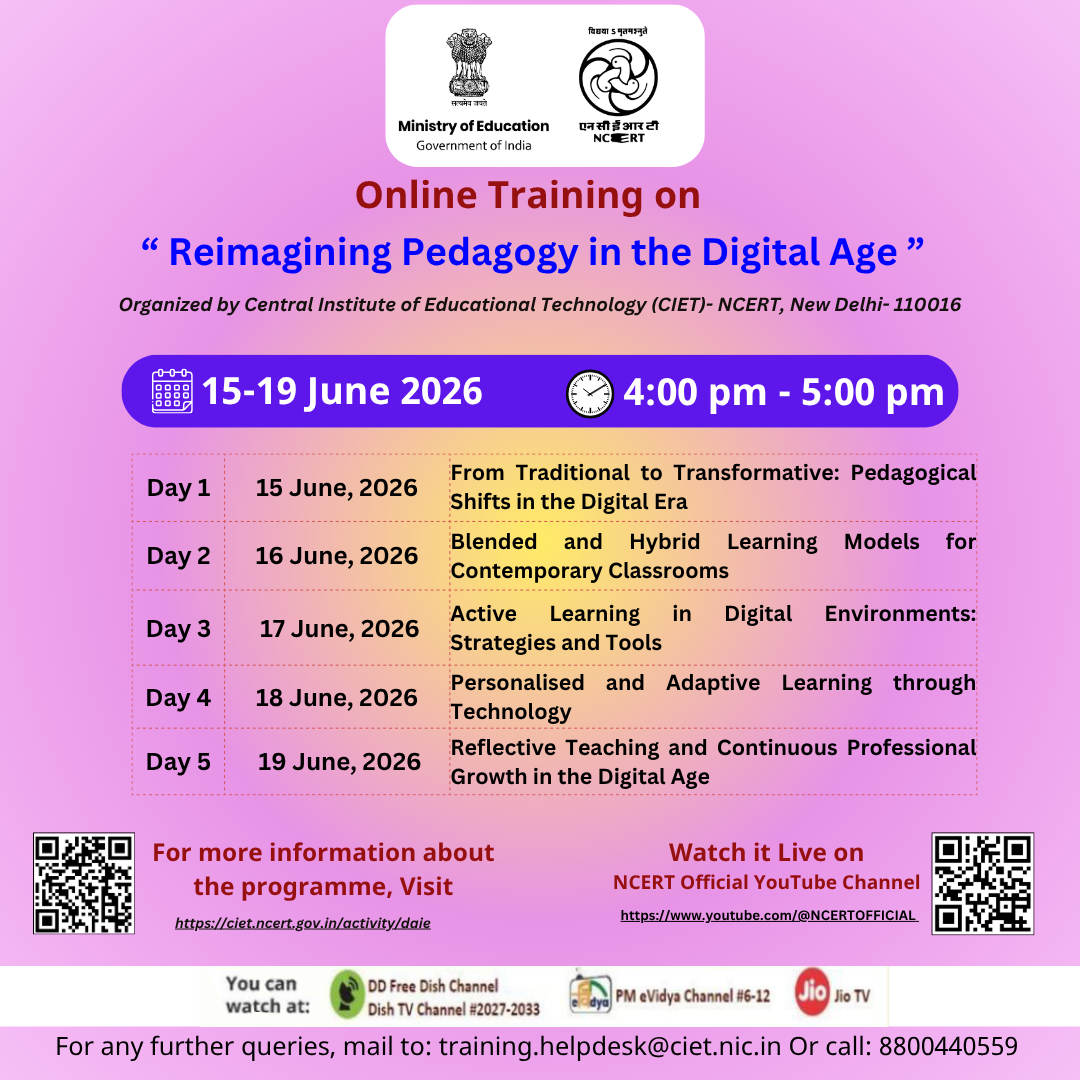
"Reimagining Pedagogy in the Digital Age"
The National Education Policy (NEP) 2020 highlights the transformative potential of technology in enhancing the
quality, accessibility, equity, and effectiveness of education in chapter 23 on ‘Technology Use and Integration’.
It also advocates the meaningful use of digital innovations to enrich teaching-learning processes, strengthen
teacher professional development, and foster creativity, critical thinking, collaboration, and other 21st-century
competencies among learners (Paras 23.1, 23.5, 23.6, and 23.8). In alignment with this vision, the National
Curriculum Framework for School Education (NCF-SE) 2023 emphasises learner-centred, competency-based, and
inclusive education, supported by educational technology that enables active participation, personalised learning
pathways, assessment, and continuous professional growth of teachers (Chapter 6: Educational Technology, Sections
6.2). Similarly, the National Curriculum Framework for Foundational Stage (NCF-FS) 2022 advocates play-based,
experiential, and inquiry-oriented approaches that are responsive to children's developmental needs, while
recognising the value of appropriate digital resources in enriching educational experiences and supporting diverse
learners (section 5.4).
In the current educational landscape, the increasing integration of digital technologies has reshaped the way
teaching and learning are designed, delivered, and experienced. Classrooms are evolving from traditional
instructional settings to dynamic learning environments that support collaboration, flexibility, creativity, and
learner engagement. The growing use of online platforms, digital resources, artificial intelligence (AI), and
interactive technologies has expanded opportunities for blended and hybrid learning, personalised instruction, and
meaningful learner participation. As educational practices continue to evolve, teachers are required to adopt
innovative pedagogical approaches that foster critical thinking, problem-solving, collaboration, and self-directed
learning among students. Furthermore, emerging technologies provide opportunities to address diverse learner
needs, support data-informed decision-making, and strengthen continuous professional development. These
developments underscore the need to reimagine pedagogy in ways that leverage the potential of digital technologies
to create learner-centred, inclusive, engaging, and future-ready learning experiences.
In this context, CIET-NCERT is organising an online training series on “Reimagining Pedagogy in the Digital Age”
to strengthen the capacities of teachers, teacher educators, prospective teachers, school leaders, and other
stakeholders in understanding and implementing contemporary pedagogical approaches in digitally enriched learning
environments. The training aims to develop participants’ understanding of pedagogical shifts in the digital era,
explore innovative teaching-learning models and strategies, examine the role of technology in supporting learner
engagement and personalised learning, and promote reflective professional practices for continuous growth and
improvement. The programme will provide participants with opportunities to explore practical strategies, digital
tools, and emerging trends that can help create meaningful, inclusive, and future-ready learning experiences.
Objectives of Training:
On completion of the training series , the learners will be able to:
- Understand the pedagogical shift from traditional teacher-centred approaches to learner-centred, technology-enabled teaching and learning practices.
- Apply blended and hybrid learning models, including flipped classroom strategies, in contemporary classrooms.
- Use active learning strategies and digital tools to enhance learner engagement, collaboration, and problem-solving.
- Explore personalised and adaptive learning approaches supported by digital and AI-enabled technologies.
- Strengthen reflective teaching practices and continuous professional growth through digital tools and professional learning networks.
Programme Schedule:
Reimagining Pedagogy in the Digital Age: 15-19 June, 2026| Day & Date | Title of the Session | Name of the Resource Persons | Banner Link | Presentation link | Video Link |
|---|---|---|---|---|---|
|
Day 1: Monday 15 June, 2026 |
From Traditional to Transformative: Pedagogical Shifts in the Digital Era | Dr. Monica Nagpal, Visiting Assistant Professor, SOER, MIT-ADT University, Pune, Maharashtra. | Day 1 | Presentation-1 | Video |
|
Day 2: Tuesday 16 June, 2026 |
Blended and Hybrid Learning Models for Contemporary Classrooms | Dr. Mohd Mamur Ali, Assistant Professor, Department of Teacher Training and Non-formal Education, IASE, JMI, New Delhi. | Day 2 | Presentation-2 | Video |
|
Day 3: Thursday 17 June, 2026 |
Active Learning in Digital Environments: Strategies and Tools | Dr. Ruchi Dwivedi, Assistant Professor, MPD CIET-NCERT | Day 3 | Presentation-3 | Video |
|
Day 4: Friday 18 June, 2026 |
Personalised and Adaptive Learning through Technology | Dr. Biju K, Assistant Professor, Central University of Tamil Nadu. | Day 4 | Presentation-4 | Video |
|
Day 5: Monday 19 June, 2026 |
Reflective Teaching and Continuous Professional Growth in the Digital Age | Dr. Kanak Sharma, Assistant Professor, Department of Education, Central University of Rajasthan | Day 5 | Presentation-5 | Video |
|
Organising Team Programme Advisory:
Prof. Amarendra P. Behera, Joint Director, CIET-NCERT, New Delhi.
Programme Coordinator and Course Coordinator : Dr. Angel Rathnabai, Associate Professor, CIET-NCERT, New Delhi. Technical Coordinator:
Ms. Aakansha, Academic Consultant, CIET-NCERT, New Delhi.
|
|||||
Modality
The sessions of this online training will be broadcast live on NCERT’s Official YouTube Channel - https://youtube.com/ncertofficial and simulcast on PM e-Vidya DTH TV Channels (6–12) from 4.00 pm - 5.00 pm. The session will also be telecast live on the following channels:
- DD Free Dish Channel
- DISH TV Channel #2027-2033
- Jio TV mobile app
Recorded sessions will also be available through a dedicated YouTube playlist. Learners can watch these live
sessions/ recorded recorded sessions to enhance their understanding of that particular theme.
If learners want to earn a certificate that is considered as part of the 50 hours of CPD, then they
should join the online course offered through DIKSHA using the course link that will be made available on the last
day of the live session. Once the learner joins the course and completed the following, they will receive the
digital certificate in the portal itself. The certificate will be available in their profile page as well. They can
download the certificate and also access the certificate in the digilocker.
- Consume all the digital resources provided in the course
- Participate in the activities given in the course
- Take the final assessment and score 70% and above within three attempts
- Fill the feedback form
How to take part in the course?
Important Dates:
| Course Title | Dates |
|---|---|
| Reimagining Pedagogy in the Digital Age |
Live Session: 15-19 June, 2026 Course Enrolment Opening Date: 22 June, 2026 Course Enrolment Closing Date: 10 March 2027 Course Closing Date: 15 March 2027 |
Learners who want to attend live session but do not aim for certificate, follow the given step:
- Watch the live sessions in NCERT official YouTube channel/ PM eVidya DTH TV channel and interact with the
experts. Recording of the sessions can also be accessed from the playlist link:
https://www.youtube.com/playlist?list=PLcsj1x9n9h4iO5H228UZ-KgUnpDQO2ewS
Learners who aim for certificate, follow the given steps:
- Step 1: Register in DIKSHA. Link your APAAR ID and digi locker ID (If you do not have an APAAR or Digilocker ID, create one and then add the details in the DIKSHA portal). If this is already done, this step may be skipped.
- Step 2: Join the online course using the course link - https://learning.diksha.gov.in/diksha/course.php?id=1414§ion=2875
(Refer to the tutorial to understand the process of joining a course - https://www.youtube.com/playlist?list=PLcsj1x9n9h4j0TtGCy_jKJyEX7y6mD6Rs). - Step 3: Watch the videos given inside the course.
- Step 4: Complete all the activities given in the course, like discussion forum, interactive activities, assignments etc.,
- Step 5: Take the final assessment. Three attempts can be tried. 70% and above is the eligibility to get a certificate. In case you couldn't get 70% and above within three attempts, you will not be eligible to get a certificate.
- Step 6: Learners who meet all the criteria will get the digital certificate, and they can access the certificate in their profile page.
For any queries, mail to:training.helpdesk@ciet.nic.in or call: 8800440559.