
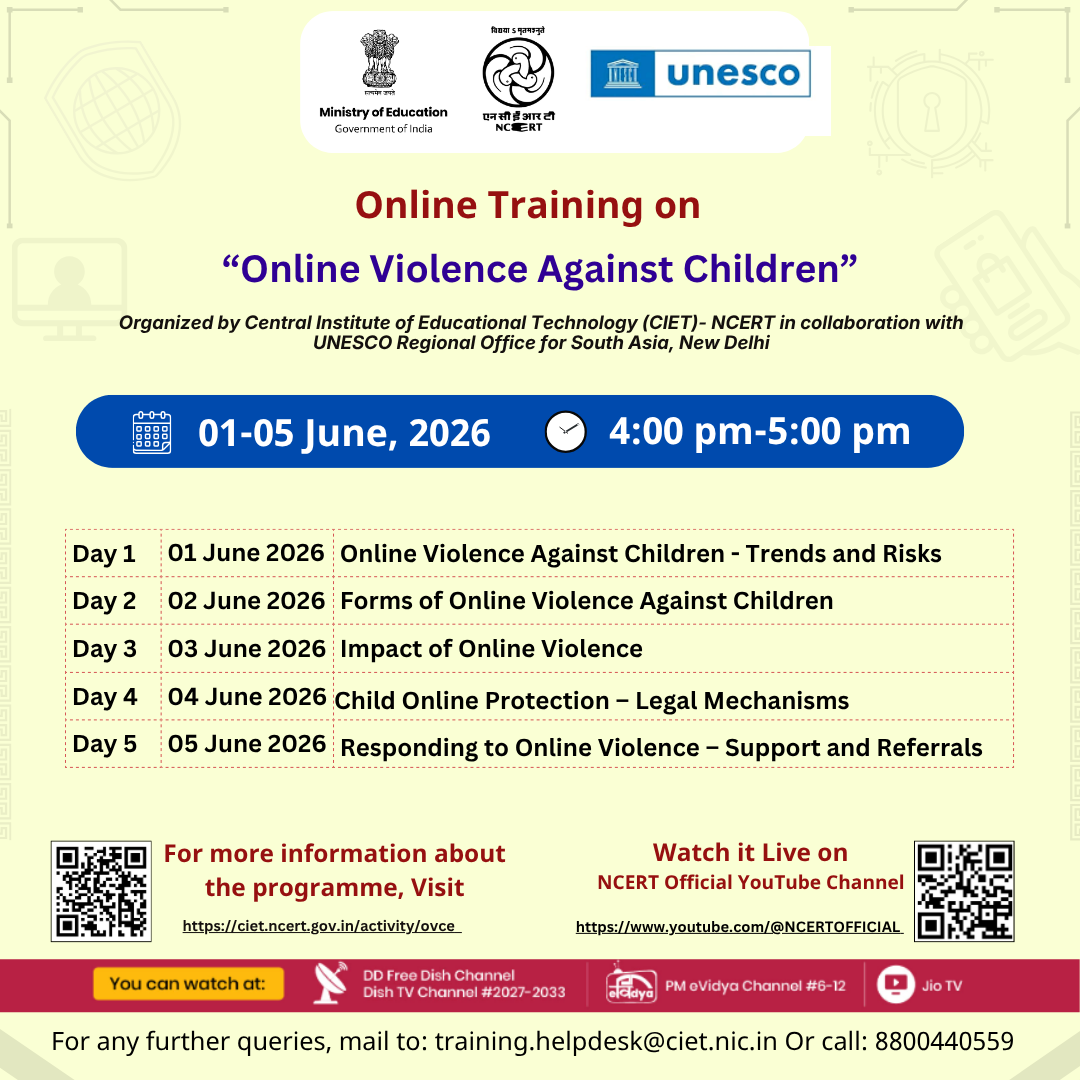
Online Training Series on
"Online Violence Against Children"
The National Education Policy (NEP) 2020 places a strong emphasis on integrating digital technologies to improve educational access, equity, and quality while also highlighting the importance of safeguarding learner safety, wellbeing, and ethical participation in digital spaces. It acknowledges that as digital access grows, there is a corresponding need to safeguard children from emerging online dangers and encourage responsible use of the internet. The National Curriculum Framework for School Education (NCF-SE 2023, Part B, Section 6.4) emphasizes the significance of digital literacy, digital citizenship, ethical awareness, and responsible technology use as critical competencies for students in line with this vision. It emphasises that children require structured guidance and support to navigate digital environments safely and responsibly, while integrating life skills, values, and socio-emotional learning within the context of digital engagement.
The digital landscape for children has evolved into a complex ecosystem where the boundaries between physical and virtual safety have effectively vanished. For educators, awareness of online violence is no longer a peripheral IT concern but a core component of modern safeguarding. As social interactions increasingly migrate to platforms driven by aggressive algorithms and generative AI, the forms of abuse have become more sophisticated. Teachers must now contend with AI-generated deepfakes used for peer humiliation, "gamified" grooming within educational and gaming apps, and the rapid-fire spread of viral cyberbullying that can traumatize a student before a school day even begins. Without a high level of awareness, these digital threats remain invisible to the adult eye, leaving students to navigate a high-stakes environment without a safety net.
Teachers serve as the critical "front line" because they are often the first to witness the behavioral fallout of digital trauma, such as sudden academic decline, social withdrawal, or heightened anxiety during device-based lessons. Unlike parents, who may only see a child’s behavior at home, teachers observe the social dynamics and peer pressures that fuel online aggression. By integrating digital citizenship into the curriculum, educators can shift from a reactive stance by simply putting out fire to a proactive one, teaching students how to develop emotional resilience and ethical digital habits. Furthermore, when teachers are well-versed in reporting protocols and the legal nuances of digital evidence, they bridge the "reporting gap," providing a trusted pathway for students who might otherwise suffer in silence for fear of losing their digital privileges.
Thus, the need for teacher awareness is driven by the severe consequences of inaction. Online violence is directly linked to a surge in youth mental health crises, including chronic depression and self-harm. In an era where a student's digital reputation can be weaponized in seconds, the school must be a sanctuary where technology is a tool for growth rather than a medium for harm. By committing to continuous professional development and fostering a culture of transparent communication, schools can ensure that teachers are not just instructors of subjects, but guardians of a child’s holistic well-being in an interconnected world.
In this context, CIET-NCERT in collaboration with UNESCO Regional Office for South Asia, New Delhi is organising an online training on ‘Online Violence against Children’ to sensitise learners and educators to online risks and promote safe behaviour in the digital space. The programme aims to build awareness, strengthen preventive skills, and foster responsible and ethical digital engagement among learners.
Objectives of Training:
On completion of the training series , the learners will be able to:
- Explain the emerging trends in online violence against children
- Identify and classify the various forms of online violence
- Describe the impact of online violence on children
- Identify the roles of various stakeholders of school education in preventing and responding to online violence
- Outline legal provisions for child protection
Programme Schedule:
Online Violence Against Children: 01-05 June, 2026| Day & Date | Title of the Session | Name of the Resource Persons | Banner Link | Presentation link | Video Link |
|---|---|---|---|---|---|
|
Day 1: Monday 01 June, 2026 |
Online Violence Against Children-Trends and Risks | Ms. Sarita Jadav, National Programme Officer, UNESCO | Day 1 | Presentation-1 | Video |
|
Day 2: Tuesday 02 June, 2026 |
Forms of Online Violence Against Children | Ms. Meghmala Mukherjee, Member of UNESCO Chair on Bullying and Cyberbullying, Dublin City University | Day 2 | Presentation-2 | Video |
|
Day 3: Thursday 03 June, 2026 |
Impact Online Violence | Dr. Yatan Pal Balhara, Professor of Psychiatry, AIIMS | Day 3 | Presentation-3 | Video |
|
Day 4: Friday 04 June, 2026 |
Child Online Protection – Legal Mechanisms | Mr. Manoj Kumar, ACP, Delhi Police | Day 4 | Presentation-4 | Video |
|
Day 5: Monday 05 June, 2026 |
Responding to Online Violence – Support and Referrals | Major Sadhna Singh(Retd), Lead Architect, NITI Frontier Tech Hub | Day 5 | Presentation-5 | Video |
|
Organising Team Programme Advisory:
Prof. Amarendra P. Behera, Joint Director, CIET-NCERT, New Delhi.
Programme Coordinator and Course Coordinator : Dr. Angel Rathnabai, Associate Professor, CIET-NCERT, New Delhi. Collaborator(s): Ms. Sarita Jadav, National Programme Officer, UNESCO, Chanakyapuri, New Delhi. Technical Coordinator:
Ms. Aakansha, Academic Consultant, CIET-NCERT, New Delhi.
|
|||||
Modality
The sessions of this online training will be broadcast live on NCERT’s Official YouTube Channel - https://youtube.com/ncertofficial and simulcast on PM e-Vidya DTH TV Channels (6–12) from 4.00 pm - 5.00 pm. The session will also be telecast live on the following channels:
- DD Free Dish Channel
- DISH TV Channel #2027-2033
- Jio TV mobile app
Recorded sessions will also be available through a dedicated YouTube playlist. Learners can watch these live sessions/ recorded recorded sessions to enhance their understanding of that particular theme.
If learners want to earn a certificate that is considered as part of the 50 hours of CPD, then they should join the online course offered through DIKSHA using the course link that will be made available on the last day of the live session. Once the learner joins the course and completed the following, they will receive the digital certificate in the portal itself. The certificate will be available in their profile page as well. They can download the certificate and also access the certificate in the digilocker.
- Consume all the digital resources provided in the course
- Participate in the activities given in the course
- Take the final assessment and score 70% and above within three attempts
- Fill the feedback form
How to take part in the course?
Important Dates:
| Course Title | Dates |
|---|---|
| Online Violence Against Children |
Live Session: 01-05 June, 2026 Course Enrolment Opening Date: 05 June 2026 Course Enrolment Closing Date: 10 March 2027 Course Closing Date: 15 March 2027 |
Learners who want to attend live session but do not aim for certificate, follow the given step:
- Watch the live sessions in NCERT official YouTube channel/ PM eVidya DTH TV channel and interact with the experts. Recording of the sessions can also be accessed from the playlist link:
https://www.youtube.com/playlist?list=PLcsj1x9n9h4g-_-_3olD10uKrWi5aOFrr
Learners who aim for certificate, follow the given steps:
- Step 1: Register in DIKSHA and link your APAAR ID and digi locker ID (If you do not have an APAAR or Digilocker ID, create one following the tutorial - ). If this is already done, this step may be skipped.
- Step 2: Join the online course using the course link - https://learning.diksha.gov.in/diksha/course.php?id=1357§ion=2788&modeActive=8879
(Refer to the tutorial to understand the process of joining a course - https://www.youtube.com/playlist?list=PLcsj1x9n9h4j0TtGCy_jKJyEX7y6mD6Rs). - Step 3: Watch the videos given inside the course.
- Step 4: Complete all the activities given in the course, like discussion forum, interactive activities, assignments etc.,
- Step 5: Take the final assessment. Three attempts can be tried. 70% and above is the eligibility to get a certificate. In case you couldn't get 70% and above within three attempts, you will not be eligible to get a certificate.
- Step 6: Learners who meet all the criteria will get the digital certificate, and they can access the certificate in their profile page.
For any queries, mail to:training.helpdesk@ciet.nic.in or call: 8800440559.